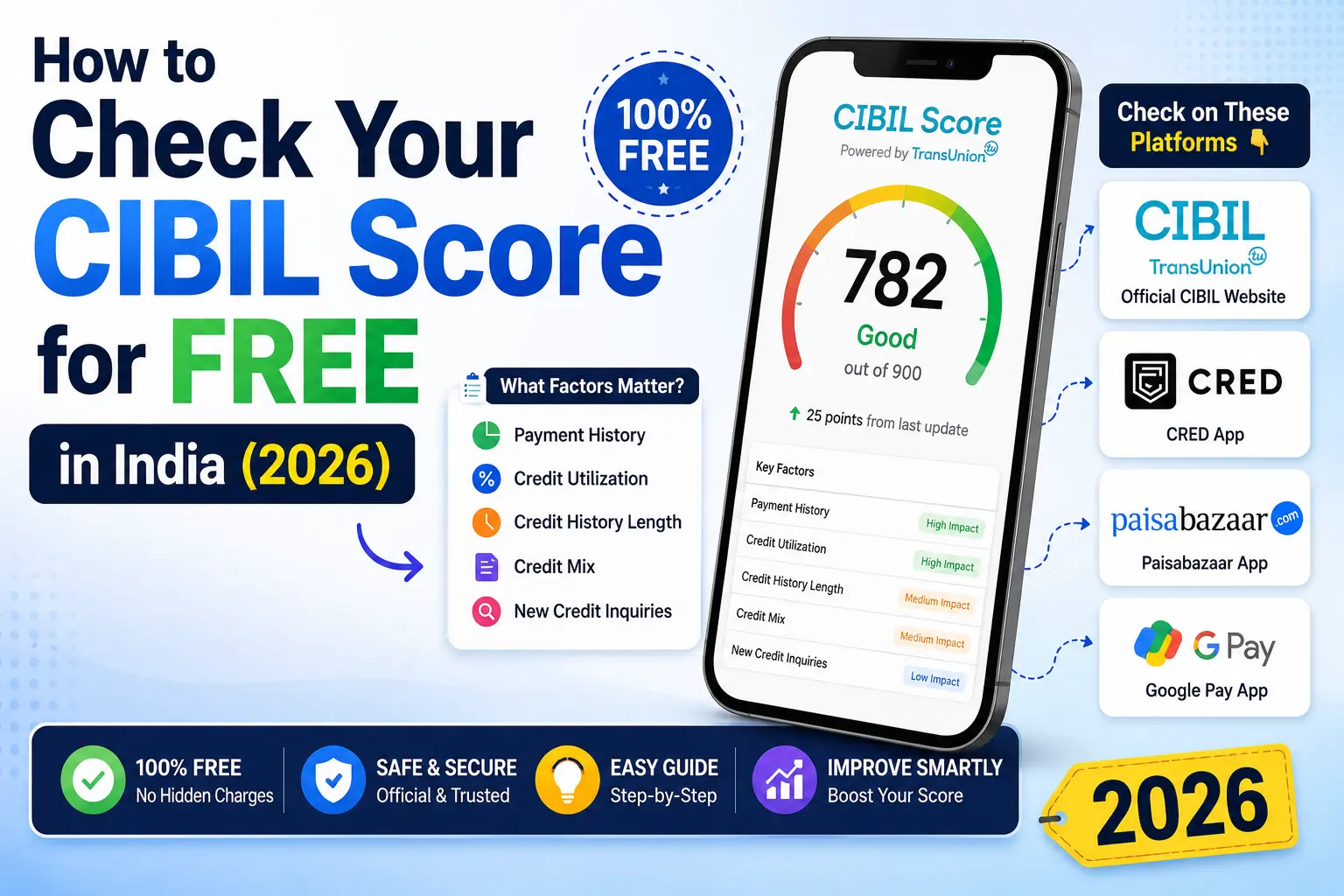

Most Indians discover their CIBIL score for the first time when a bank rejects their application. 💳 That’s the worst moment to find out. Checking your score takes under 5 minutes, costs absolutely nothing, and — contrary to what most people think — does not affect your score at all.
In this guide, we show you exactly how to check your CIBIL score for free, where to check it, and what every section of your credit report actually means in plain language.
Table of Contents
- Does Checking Your Score Affect It?
- Where to Check Your CIBIL Score for Free
- Step-by-Step — How to Check on Each Platform
- Understanding Your CIBIL Score Range
- What Each Factor in Your CIBIL Report Means
- How to Spot and Fix Errors
- How Often Should You Check?
- What to Do Based on Your Score
Does Checking Your Own CIBIL Score Affect It?
No — and this is the most common reason people avoid checking.
When you check your own score, it is called a soft inquiry. Soft inquiries are completely invisible to lenders and have zero impact on your score.
A hard inquiry, on the other hand, happens when a bank checks your score after you apply for a credit card or loan. Multiple hard inquiries in a short period do lower your score. Since checking it yourself is always a soft inquiry, you can check as often as you want without any consequence.
Where to Check Your CIBIL Score for Free
| Platform | Free Checks | Score + Full Report | Best For |
|---|---|---|---|
| CIBIL.com | 1 per year (full report) | ✅ Both | Official source — most detailed |
| Paisabazaar | Once a month | ✅ Both | Most popular, quick access |
| CRED | Once a month | Score only | Existing credit card users |
| Google Pay | Unlimited | Score only | Fastest check — under 60 seconds |
Step-by-Step — How to Check on Each Platform
CIBIL.com — Official Source
- Go to cibil.com → click “Get Your Free Credit Score”
- Create an account — enter PAN, date of birth, and email
- Verify identity — answer questions about past loans or cards
- Your score and full report appear on your dashboard instantly
- Download your full report — free once every year
Paisabazaar
- Open Paisabazaar App → click “Free Credit Score”
- Enter your mobile number and PAN card
- Verify via OTP
- Score and report appear immediately — unlimited free checks
CRED
- Open the CRED app → go to the Credit Score section
- Enter PAN card details
- Score appears instantly — refreshes monthly automatically
Google Pay
- Open Google Pay → tap your profile photo
- Select “Credit Score” from the menu
- Enter PAN and verify — score appears in under 60 seconds
- Score only — no full report available here
Understanding Your CIBIL Score Range
| Score Range | Rating | What It Means |
|---|---|---|
| 300 – 549 | Poor | Most applications get rejected. Priority is improvement. |
| 550 – 649 | Fair | Limited options. Secured cards are the best starting point. |
| 650 – 749 | Good | Most entry-level cards approved. Room to improve further. |
| 750 – 799 | Very Good | Strong approval chances. Good card offers available. |
| 800 – 900 | Excellent | Best cards, lowest interest rates, fastest approvals. |
“A score of 750 and above puts you in the top tier of credit applicants in India — most banks approve instantly and offer their best card variants at this level.” — Simplix Finance Desk
What Each Factor in Your CIBIL Report Means
This is the section most guides skip. Your CIBIL report shows far more than just a number — and understanding each factor tells you exactly what is helping or hurting your score.
| Factor | What It Means | Weight |
|---|---|---|
| On-Time Payments | Your history of paying credit card bills and loan EMIs on time. The single biggest factor in your score. Even one missed payment creates a negative mark. | ~35% |
| Credit Utilisation | How much of your total credit limit you use monthly. Ideal is below 30%. Using ₹9,000 of a ₹10,000 limit signals financial stress to banks — even if you pay on time. | ~30% |
| Account Age | How long your oldest and average credit accounts have been active. Older accounts signal stability. Closing your first card shortens this — which is why keeping old cards open matters. | ~15% |
| Types of Accounts | The mix of secured loans (home, car) and unsecured credit (cards, personal loans) in your profile. A healthy mix scores better than only one type. | ~10% |
| Enquiries | Every time a bank checks your score after a card or loan application, it shows as a hard enquiry. Too many in a short period signals desperation to lenders and lowers your score. | ~10% |
How to Spot and Fix Errors
Errors in CIBIL reports are more common than most people realise — wrong personal details, closed accounts still showing as active, or loans you never took appearing in your history.
How to raise a dispute:
- Log in to cibil.com → go to “Dispute Centre”
- Select the account or field with the error
- Submit your dispute with supporting documents
- CIBIL forwards it to the relevant bank or lender
- Resolution typically takes 30 days
Check these three things specifically every time you view your report:
- Personal details — PAN, name, date of birth, address
- Closed accounts — confirm they show as “Closed” not “Active”
- Accounts you don’t recognise — these could signal identity fraud
How Often Should You Check?
Once every 3 months is the right frequency for most people.
Monthly checks are unnecessary unless you’re actively applying for a loan or card. Annual checks are too infrequent — errors and fraudulent accounts can go unnoticed for months. Quarterly monitoring gives you enough visibility to catch problems early without obsessing over small monthly fluctuations.
What to Do Based on Your Score
Score 750 and above — You’re in great shape. You qualify for India’s best credit cards. Start with lifetime free options or high-cashback cards to maximise rewards on your everyday spending. → Best Lifetime Free Credit Cards in India (2026) → Best Cashback Credit Cards in India (2026)
Score 600–749 — Good start, room to improve. You qualify for most entry-level cards. Focus on paying on time, keeping utilisation below 30%, and avoiding new applications for 6 months while your score builds. → Best Credit Cards for Beginners in India (2026)
Score below 600 or no score — Start building from scratch. A secured card against a fixed deposit is your most reliable path forward. It guarantees approval, builds your credit history immediately, and costs nothing beyond the FD investment. → Best Secured Credit Cards in India (2026)
Also read: What Is a CIBIL Score? How It Works and Why It Matters