
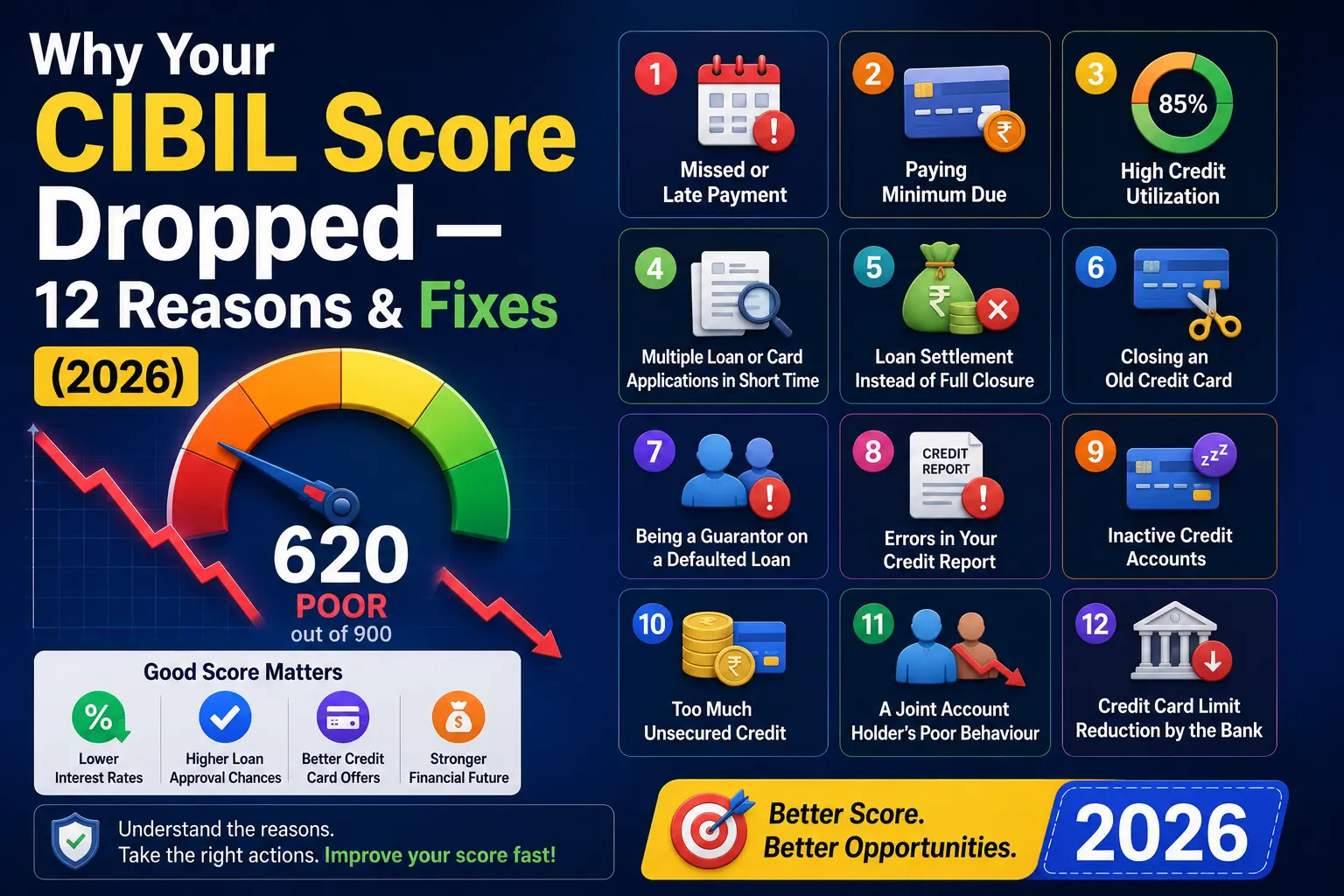

You checked your CIBIL score last month and it was fine. You check again today and it has dropped — sometimes by 20 points, sometimes by 80. No new loans, no missed payments you remember. So what happened? 💳
This is one of the most common questions Indians ask about their credit score. The answer is almost always one of a specific set of reasons — and every single one of them is fixable. Since your CIBIL score updates monthly based on data reported by banks and lenders, even small changes in your credit behaviour show up quickly.
In this guide, we cover all 12 reasons your CIBIL score may have dropped, the fix for each one, and how long recovery realistically takes.
Table of Contents
- How Quickly Can a Score Drop?
- 12 Reasons Your CIBIL Score Dropped — and How to Fix Each
- Quick Reference — Reasons, Impact & Fix Table
- How Long Does Recovery Take?
- Normal Fluctuation vs Genuine Drop — Know the Difference
- What to Do Right Now
- Next Steps
How Quickly Can a Score Drop?
Scores drop faster than they rise — and that asymmetry catches most people off guard.
A single missed payment can drop your score by 50–100 points within one billing cycle. A loan settlement can drop it by 75–150 points and stays on your report for 7 years. Multiple hard enquiries in a short period can shave off 10–15 points each.
In contrast, rebuilding those points takes consistent positive behaviour over months — sometimes years for serious negative marks. Consequently, understanding why your score dropped is the first and most important step toward fixing it.
12 Reasons Your CIBIL Score Dropped — and How to Fix Each
Reason 1 — Missed or Late Payment
What happened: You missed a credit card due date or paid after the due date. Even one day late counts as a late payment on your CIBIL report.
Impact: High — late payments account for approximately 35% of your score. A single missed payment can drop your score by 50–100 points immediately.
Fix: Pay the overdue amount immediately. Set auto-pay for the full outstanding amount going forward. The negative mark stays on your report for up to 3 years — but consistent on-time payments after the incident gradually reduce its impact.
Reason 2 — Paying Only the Minimum Due
What happened: You paid the minimum due instead of the full outstanding amount. While this keeps your account technically active, many lenders interpret consistent minimum due payments as financial stress.
Impact: Medium — not as damaging as a missed payment but signals poor financial health to credit bureaus over time. Read our full guide on the minimum due trap →
Fix: Switch to full outstanding payment every month without exception. Set auto-pay for the total due — not the minimum due.
Reason 3 — High Credit Utilisation
What happened: You spent a large portion of your available credit limit in a single month. Using above 30% of your total credit limit consistently signals financial pressure to credit bureaus.
Impact: Medium-High — credit utilisation accounts for approximately 30% of your score. Using 80–90% of your limit can drop your score by 30–50 points even with perfect payment history.
Fix: Keep monthly spending below 30% of your total credit limit. If your spending genuinely requires more, request a credit limit increase from your bank — your spending stays the same but your utilisation ratio drops immediately.
Reason 4 — Multiple Loan or Card Applications in a Short Period
What happened: You applied for multiple credit cards or loans within a few months. Every application triggers a hard enquiry on your report — and multiple hard enquiries signal desperation to lenders.
Impact: Medium — each hard enquiry lowers your score by 5–15 points. Three or four applications in 60 days creates a visible pattern that compounds the drop.
Fix: Space credit applications at least 6 months apart. Research eligibility thoroughly before applying — a rejection triggers a hard enquiry with no benefit.
Reason 5 — Loan Settlement Instead of Full Closure
What happened: You settled a loan by paying less than the full outstanding amount — either through negotiation with the bank or a one-time settlement offer. The account now shows as “Settled” on your report instead of “Closed.”
Impact: Very High — a Settled status is treated almost as negatively as a default by most lenders. It stays on your report for 7 years and can drop your score by 75–150 points.
Fix: If possible, pay the remaining balance to convert the status from “Settled” to “Closed.” Contact the lender, pay the difference, and request a No Objection Certificate (NOC). This is the only way to clean this mark from your report.
Reason 6 — Closing an Old Credit Card
What happened: You closed a credit card you no longer use — especially your oldest one. Closing it shortened your average account age and removed that positive history from your profile.
Impact: Medium — account age contributes approximately 15% to your score. Closing an account that is several years old can drop your score by 20–40 points depending on how much history it carried.
Fix: Keep your oldest credit card active with at least one small transaction every 3 months. A ₹100 utility bill is enough to maintain the account without any cost. If the card has an annual fee, call the bank and request a fee waiver or downgrade to a no-fee variant.
Reason 7 — Being a Guarantor on a Defaulted Loan
What happened: You signed as a guarantor on someone else’s loan — a family member or friend — and they defaulted or missed payments. Since you guaranteed the loan, their default reflects directly on your CIBIL report.
Impact: High — a guarantor is treated as a co-borrower by credit bureaus. Their missed payments become your missed payments on paper.
Fix: Contact the lender immediately. Request to be removed as guarantor — this requires the primary borrower to arrange an alternate guarantor or pay the outstanding amount. Going forward, avoid signing as guarantor unless you are fully prepared to repay the loan yourself if needed.
Reason 8 — Errors in Your Credit Report
What happened: Your report contains incorrect information — a closed account still showing as active, a loan you never took, a wrong late payment record, or incorrect personal details. These errors lower your score without reflecting your actual behaviour.
Impact: Varies — depending on the type of error, impact can range from minor to severe. Fraudulent accounts appearing on your report can drop your score by 100+ points.
Fix: Check your full CIBIL report quarterly. Raise a dispute on cibil.com for any incorrect entry — resolution typically takes 30 days. Learn how to check your report for free →
Reason 9 — Inactive Credit Accounts
What happened: You stopped using a credit card entirely. Banks sometimes close dormant accounts after a period of inactivity — which shortens your account age and reduces your total available credit limit simultaneously.
Impact: Medium — both the account age reduction and the drop in available credit limit can combine to lower your score by 20–40 points.
Fix: Use every credit card you hold for at least one small transaction every 3 months. Set a recurring small bill — like a streaming subscription or utility payment — on each card to keep it active automatically.
Reason 10 — Too Much Unsecured Credit
What happened: Your credit profile has too many unsecured credit products — multiple personal loans, several credit cards — without any secured credit like a home loan or car loan to balance it. Credit bureaus view a heavy unsecured credit mix as higher risk.
Impact: Low-Medium — contributes approximately 10% to your score. The impact grows if unsecured credit utilisation is also high.
Fix: Avoid taking additional unsecured credit unless genuinely needed. Over time, adding a secured credit product — even an FD-backed card — improves your credit mix naturally.
Reason 11 — A Joint Account Holder’s Poor Behaviour
What happened: You hold a joint loan or joint account with someone — a spouse, business partner, or family member — and they missed payments or defaulted. Since the account is joint, their behaviour reflects directly on your CIBIL report too.
Impact: High — same as a missed payment on your own account. The negative mark appears on both credit profiles simultaneously.
Fix: Monitor joint accounts as closely as your individual ones. If the joint account holder has poor credit habits, consider restructuring the account or closing it if feasible. Going forward, be selective about joint financial commitments.
Reason 12 — Credit Card Limit Reduction by the Bank
What happened: Your bank reduced your credit card limit — sometimes without notifying you. This happens during periodic credit reviews when banks reassess risk. Even if your spending stayed the same, a lower limit means higher utilisation automatically.
Impact: Medium — if your limit dropped from ₹1,00,000 to ₹50,000 and your monthly spend is ₹40,000, your utilisation just jumped from 40% to 80% overnight without you spending a rupee more.
Fix: Reduce your monthly spending on that card immediately to bring utilisation back below 30%. Alternatively, request a limit restoration — call your bank, ask for the reason for the reduction, and make a case for reinstatement based on your repayment history.
Quick Reference — Reasons, Impact & Fix Table
| Reason | Impact | Fix | Recovery Time |
|---|---|---|---|
| Missed/late payment | Very High | Pay immediately, set auto-pay | 12–24 months |
| Minimum due only | Medium | Switch to full payment | 3–6 months |
| High utilisation | Medium-High | Reduce spend or increase limit | 1–2 billing cycles |
| Multiple applications | Medium | Space applications 6 months apart | 6–12 months |
| Loan settlement | Very High | Pay remaining to convert to Closed | 7 years (mark stays) |
| Closing old card | Medium | Keep oldest card active | 6–12 months |
| Guarantor default | High | Arrange alternate guarantor | 12–24 months |
| Report errors | Varies | Raise dispute on cibil.com | 30 days post-resolution |
| Inactive accounts | Medium | Use card quarterly | 3–6 months |
| Too much unsecured credit | Low-Medium | Add secured credit over time | 6–12 months |
| Joint account default | High | Monitor joint accounts closely | 12–24 months |
| Credit limit reduction | Medium | Reduce spending, request restoration | 1–2 billing cycles |
How Long Does Recovery Take?
Recovery time depends entirely on what caused the drop.
Fastest to fix (under 60 days): Report errors, high utilisation, credit limit reduction — all of these correct quickly once the root cause is addressed.
Medium recovery (3–6 months): Minimum due habit correction, inactive accounts, multiple enquiries — consistent positive behaviour shows measurable improvement within this window.
Long recovery (12+ months): Missed payments, guarantor defaults, joint account issues — negative marks stay on your report and fade only with sustained positive repayment history over time.
Longest recovery (up to 7 years): Loan settlements and written-off accounts are the hardest to recover from. While your score can improve despite these marks, the entry itself remains visible on your report for years.
Normal Fluctuation vs Genuine Drop — Know the Difference
Not every score change requires action. Small monthly fluctuations of 5–15 points are completely normal — caused by minor changes in utilisation, statement timing, or bureau data refresh cycles.
When to act:
- Score dropped by 20+ points in a single month
- Score has been declining consistently for 3+ months
- You see an account or enquiry on your report you don’t recognise
- Your score dropped after applying for credit
When to ignore:
- Single-digit monthly fluctuation with no corresponding credit event
- Temporary dip after a large purchase that you paid off fully
- Score varies slightly between different platforms (CIBIL, Experian, Equifax report differently)
What to Do Right Now
If your CIBIL score has dropped, take these three steps immediately — in this order:
Step 1 — Check your full report Don’t just look at the score number. Pull the full report from cibil.com and review every account, every enquiry, and every payment status. Identify specifically what changed since your last check. Check your CIBIL report for free →
Step 2 — Dispute any errors immediately If you find incorrect information — wrong payment status, unrecognised account, or closed account still showing as active — raise a dispute on cibil.com right away. Resolution takes approximately 30 days and can reverse a drop that wasn’t your fault at all.
Step 3 — Set auto-pay for all accounts Regardless of what caused the drop, ensure every future payment goes out on time automatically. A single additional missed payment while you’re already recovering compounds the damage significantly.
Next Steps
Once you’ve identified the cause and started the fix, the path forward is clear.
For anyone rebuilding from scratch or recovering from a low score: → Best Secured Credit Cards in India (2026)
For a complete step-by-step improvement plan: → How to Improve Your CIBIL Score Fast in India (2026)
Also read: What Is a CIBIL Score? | How to Check Your CIBIL Score for Free
Follow Simplix on Instagram — @simplixmv — for weekly finance simplified.