

A low CIBIL score feels like a dead end. Banks reject your applications, lenders offer higher interest rates, and every financial door seems harder to open. 💳 The frustrating part is that most people don’t know what caused the drop — and therefore don’t know what to fix.
The good news is that your CIBIL score is not permanent. Every factor that controls it is within your direct control. Moreover, meaningful improvement is achievable within 3–6 months if you follow the right steps consistently. However, there are no overnight fixes — anyone promising a 100-point jump in 30 days is misleading you.
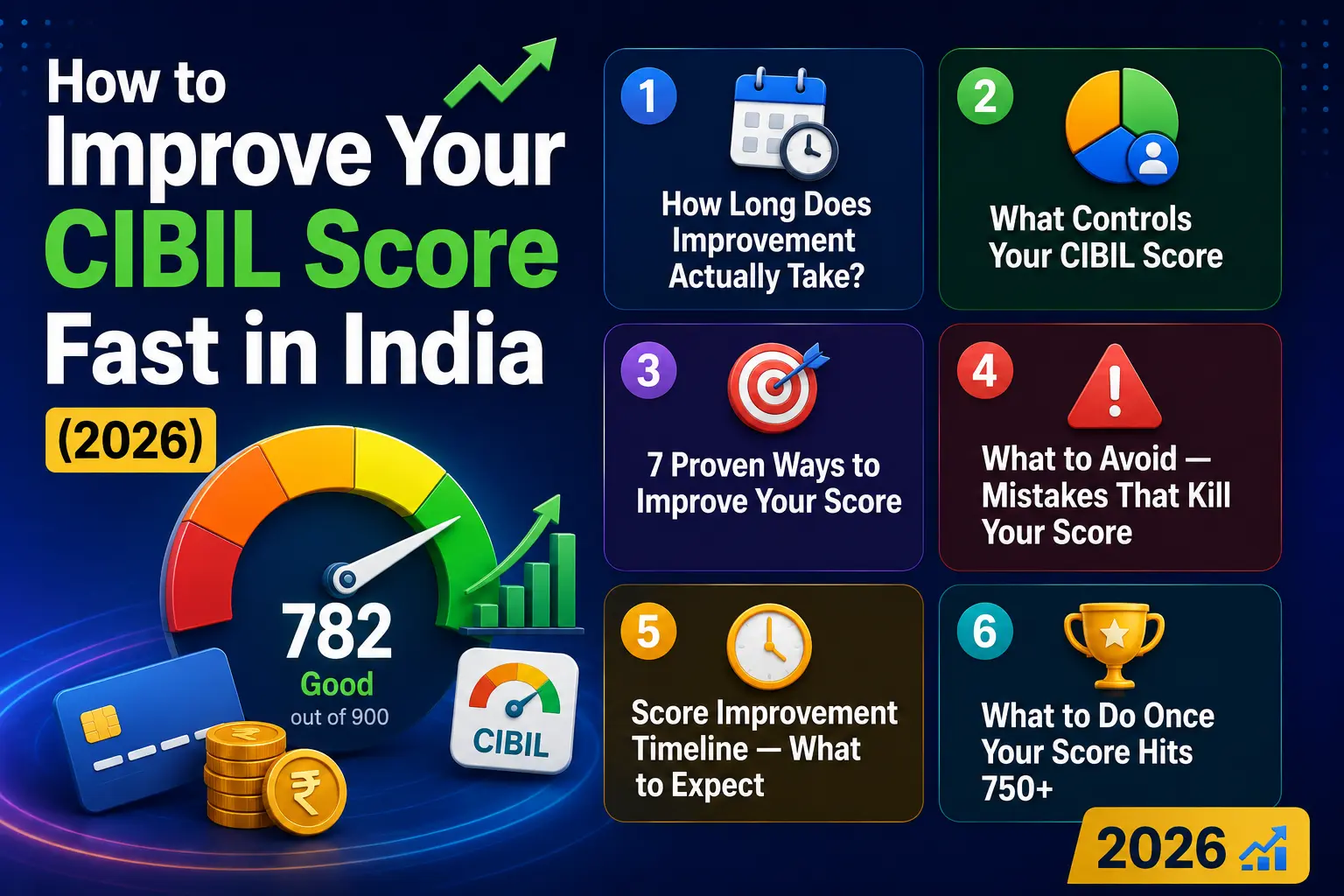
In this guide, we cover 7 proven steps to improve your CIBIL score, realistic timelines for each, and what to avoid along the way.
Table of Contents
- How Long Does Improvement Actually Take?
- What Controls Your CIBIL Score
- 7 Proven Ways to Improve Your Score
- What to Avoid — Mistakes That Kill Your Score
- Score Improvement Timeline — What to Expect
- What to Do Once Your Score Hits 750+
How Long Does Improvement Actually Take?
Before diving into tips, set realistic expectations. CIBIL score improvement is not instant — it follows your repayment behaviour over time.
| Timeframe | What You Can Realistically Achieve |
|---|---|
| 30 days | Dispute errors resolved, score corrects if errors were the cause |
| 3 months | Consistent on-time payments start reflecting positively |
| 6 months | Utilisation improvements and reduced enquiries show measurable impact |
| 12 months | Significant score improvement visible — 50 to 100+ points possible |
The fastest genuine improvement comes from two sources — correcting errors in your report and reducing credit utilisation. Both can show results within 30–60 days. Everything else takes consistent behaviour over months.
What Controls Your CIBIL Score
Understanding what drives your score tells you exactly where to focus your effort.
| Factor | Weight | What Moves It |
|---|---|---|
| On-Time Payments | ~35% | Paying full amount before due date every month |
| Credit Utilisation | ~30% | Keeping spend below 30% of your total credit limit |
| Account Age | ~15% | Keeping old accounts open and active |
| Types of Accounts | ~10% | Having a healthy mix of secured and unsecured credit |
| Enquiries | ~10% | Avoiding multiple credit applications in a short period |
Since on-time payments carry the highest weight, fixing this single habit creates the biggest positive impact on your score over time.
7 Proven Ways to Improve Your CIBIL Score
1. Always Pay the Full Amount Before the Due Date
This is the single most powerful action you can take. On-time payments account for approximately 35% of your CIBIL score — no other factor comes close.
Paying only the minimum due keeps your account technically active but does not build positive credit history the same way a full payment does. Furthermore, it triggers interest charges at 3–4% per month on the remaining balance — creating a debt cycle that makes future full payments harder. Read our full guide on the minimum due trap →
Action: Set auto-pay for the full outstanding amount the day you receive your card. Never rely on remembering the due date manually.
2. Keep Your Credit Utilisation Below 30%
Credit utilisation — how much of your total credit limit you use monthly — contributes approximately 30% to your score. Using ₹9,000 of a ₹10,000 limit every month signals financial stress to credit bureaus, even if you pay on time.
Keeping utilisation below 30% — meaning ₹3,000 on a ₹10,000 limit — signals responsible credit management. Consequently, this single change can show a measurable score improvement within 1–2 billing cycles.
Action: If your spending regularly exceeds 30% of your limit, request a credit limit increase from your bank. Your spending stays the same — your utilisation ratio drops immediately.
3. Never Close Your Oldest Credit Card
Account age contributes approximately 15% to your score. Your oldest active credit account anchors your credit history — the longer it has been open, the better it reflects on your profile.
Closing an old card, even one you no longer use, shortens your average account age and removes that history from your report. As a result, your score drops even if everything else stays the same.
Action: Keep your oldest card active with at least one small transaction every 3 months. A ₹100 utility bill payment is enough to keep the account active without any cost.
4. Avoid Multiple Credit Applications in a Short Period
Every time you apply for a credit card or loan, the bank runs a hard enquiry on your CIBIL report. Multiple hard enquiries within a few months signal desperation to lenders — and each one lowers your score marginally.
Since enquiries stay on your report for 2 years, spacing applications at least 6 months apart protects your score while still allowing you to grow your credit portfolio over time.
Action: Research cards thoroughly before applying. Apply only when you’re confident about eligibility — a rejection triggers a hard enquiry without any benefit.
5. Get a Secured Card if You Have No Score
If your CIBIL score shows -1 or NH (No History), you have no credit file yet — not a bad one. Banks cannot evaluate you without a repayment history, which is why most applications get rejected.
A secured credit card against a fixed deposit solves this immediately. Since the bank holds your FD as collateral, approval is guaranteed regardless of your score. Every on-time payment builds your credit history from month one — and within 12–18 months of clean repayment, most banks upgrade you to an unsecured card automatically.
Action: Start with a secured card at the lowest possible FD investment. Even ₹2,000–₹5,000 is enough to begin. See the best secured credit cards in India →
6. Maintain a Healthy Mix of Credit Types
Having only credit cards or only personal loans in your profile is less favourable than a combination of both. Credit bureaus reward a balanced mix — secured credit (home loans, car loans, FD-backed cards) alongside unsecured credit (credit cards, personal loans) — because it demonstrates you can manage different types of financial obligations responsibly.
Action: If you only have credit cards, consider a small personal loan or an FD-backed secured card to diversify your credit mix over time. Do not take unnecessary debt just for this — only act on this when a genuine need arises.
7. Check Your Report Quarterly and Dispute Errors Immediately
Errors in CIBIL reports are common — wrong personal details, closed accounts still showing as active, or incorrect late payment records. Since these errors directly lower your score without reflecting your actual behaviour, fixing them is the fastest route to improvement.
How to raise a dispute:
- Log in to cibil.com → go to Dispute Centre
- Select the incorrect field or account
- Submit with supporting documents
- Resolution typically takes 30 days
Action: Check your full CIBIL report once every 3 months. Learn how to check your CIBIL score for free →
What to Avoid — Mistakes That Kill Your Score
Settling a loan instead of closing it fully A settled account — where you paid less than the full outstanding amount — shows on your report as “Settled” not “Closed.” Banks treat this negatively. Always close loans completely.
Ignoring your credit card statement Fraudulent transactions and billing errors go unnoticed without monthly statement reviews — and unresolved disputes create negative marks on your report.
Applying for credit immediately after a rejection A rejection triggers a hard enquiry. Applying again immediately triggers another one. Wait at least 3–6 months, identify why you were rejected, fix the root cause, then reapply.
Using your card only for large purchases Low activity on a card can cause it to become inactive. Banks occasionally close inactive cards — which shortens your account age and lowers your score unexpectedly.
Score Improvement Timeline — What to Expect
| Month | Focus | Expected Impact |
|---|---|---|
| Month 1 | Set auto-pay, dispute errors, reduce utilisation | Score corrects if errors existed — utilisation improvement reflects within 1 billing cycle |
| Month 3 | 3 consecutive on-time full payments | Positive payment history begins building — small but measurable improvement |
| Month 6 | Consistent habits, no new applications | Credit utilisation and payment history driving steady improvement |
| Month 12 | Full year of clean repayment history | 50–100+ point improvement realistic for most profiles |
“Improving your CIBIL score is not complicated — it just requires doing the right things consistently for long enough. The habits that build a great score are the same habits that keep you financially healthy overall.” — Simplix Finance Desk
What to Do Once Your Score Hits 750+
Reaching 750 opens the door to India’s best credit card options — lifetime free cards with strong rewards, high cashback rates, and premium benefits that were previously out of reach.
You’re ready for the best cards in India: → Best Lifetime Free Credit Cards in India (2026) | Best Cashback Credit Cards in India (2026)
Also read: What Is a CIBIL Score? | How to Check Your CIBIL Score for Free
Explore more Simplix Finance guides → simplixmv.com/finance/
Follow Simplix on Instagram — @simplixmv — for weekly finance simplified.