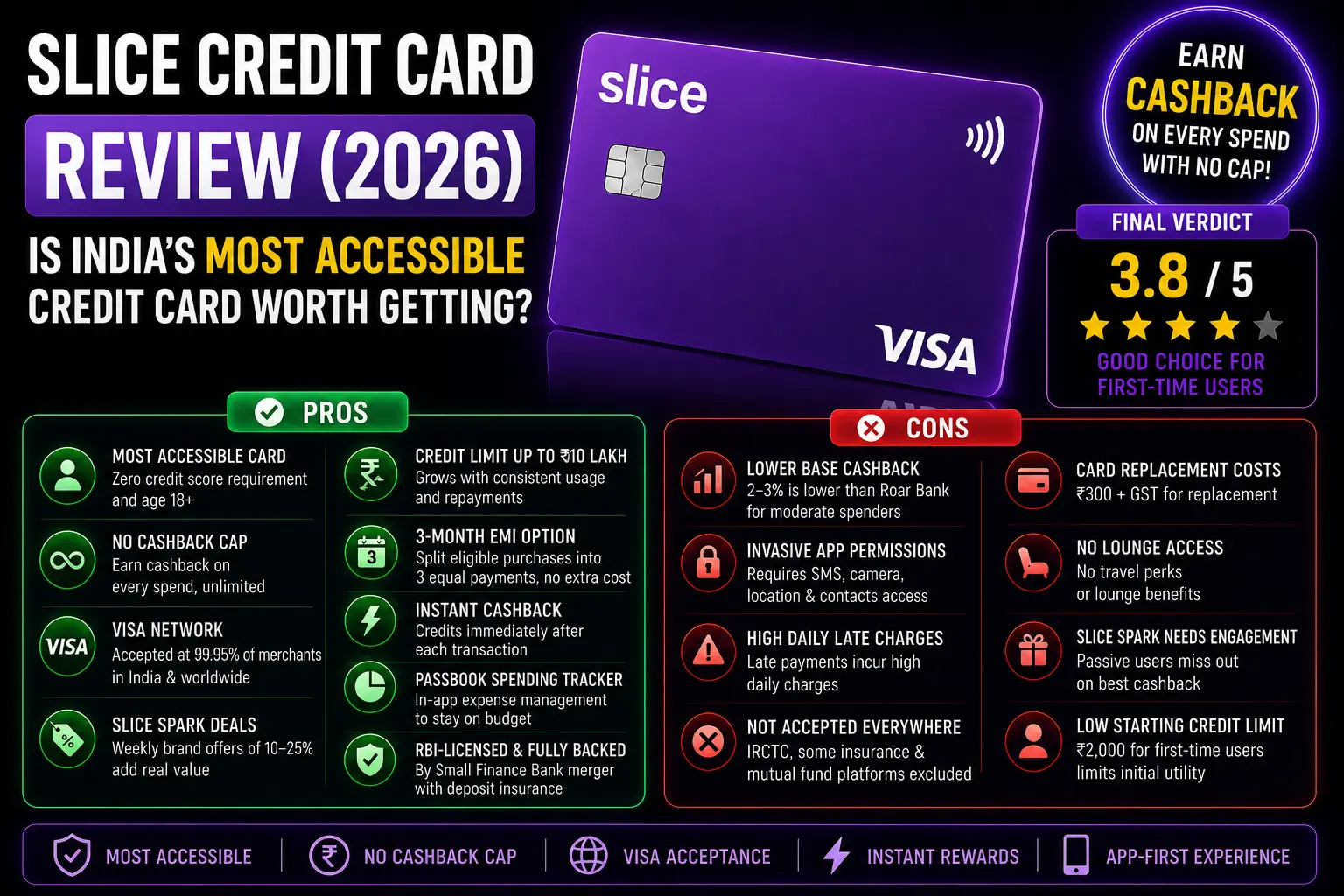

If you are 18 years old, have zero credit history, and every traditional bank has turned you away — the Slice Credit Card is probably the most talked-about solution you will come across. 📱 And for good reason.
Slice started as a BNPL fintech app and has since evolved into a full-stack bank after completing its merger with North East Small Finance Bank in October 2024. Furthermore, in July 2025, Slice launched its flagship UPI credit card — a product specifically designed for students, freelancers, and first-time credit users that major banks consistently ignore.
In this review, we break down everything about the Slice Credit Card — how it works, what the cashback actually delivers, what the fees look like, and who genuinely benefits from getting one.
Table of Contents
- What Is the Slice Credit Card?
- Key Features at a Glance
- How the Cashback Works
- Slice Spark — Weekly Brand Deals
- Fees & Charges — The Full Breakdown
- Eligibility & How to Apply
- Slice vs Roar Bank — Quick Comparison
- Pros & Cons — Our Honest Assessment
- Who Should Get This Card?
- Who Should NOT Get This Card?
- Simplix Verdict
1. What Is the Slice Credit Card?
The Slice Credit Card — officially called the Slice UPI Credit Card — is a lifetime free Visa credit card issued by Slice Small Finance Bank, the entity formed after Slice’s merger with North East Small Finance Bank. Investors including Tiger Global, Insight Partners, and Advent International back the company, giving it a significantly stronger financial foundation than most fintech startups in this space.
What makes Slice genuinely different from most entry-level cards is its approach to eligibility. Specifically, Slice accepts applicants with zero credit score — making it the most accessible credit card in India for individuals who traditional banks consistently reject. Moreover, the minimum age requirement stands at just 18 years, compared to the standard 21 years most banks require.
Additionally, the card functions as a UPI-enabled Visa card — meaning you can use it at any QR code merchant across India, not just at traditional POS terminals. In practice, this means the Slice card works at your neighbourhood grocery store, local dhaba, and street vendor — anywhere UPI payments work.
“Slice does not try to compete with HDFC or Axis. It targets the 200 million Indians that traditional banks consider too risky to serve — and gives them a real, functional credit product.” — Simplix Finance Desk
2. Key Features at a Glance
| Feature | Detail |
|---|---|
| Issuer | Slice Small Finance Bank (formerly North East Small Finance Bank) |
| Card Network | Visa |
| Joining Fee | Nil — Lifetime Free |
| Annual Fee | Nil — No spend conditions |
| Cashback Rate | Up to 3% on UPI spends, 2% on all other transactions |
| Cashback Cap | No monthly cap — earn on every rupee spent |
| Credit Limit | ₹2,000 to ₹10,00,000 — grows with usage |
| EMI Option | 3-month equal EMI split available on eligible spends |
| UPI Support | Yes — works across PhonePe, Google Pay, Paytm |
| Merchant Acceptance | 99.95% of merchants across India that accept Visa |
| Credit History Required | No — zero credit score applicants qualify |
| Minimum Age | 18 years — younger than most Indian credit cards |
| Weekly Deals | Slice Spark — 10–25% deals on partner brands |
| Spending Tracker | Passbook — visual expense management in-app |
3. How the Cashback Works
Unlike Roar Bank’s category-based cashback system, Slice takes a simpler approach — flat cashback on every transaction, with no categories to choose and no monthly cap. Consequently, every rupee you spend earns cashback automatically, regardless of what you buy or where.
The Cashback Rate Breakdown
- Up to 3% cashback on UPI spends — when you use the Slice card linked to a UPI app to pay via QR code
- Up to 2% cashback on all other transactions — online purchases, in-store POS payments, and app-based spending
- No monthly cap — your cashback accumulates on every transaction without a ceiling
Simplix Reality Check: The 2–3% cashback rate sounds lower than Roar Bank’s 20% — but the critical difference is the cap. Roar Bank limits cashback to ₹2,500 per month regardless of spend. Slice has no cap. Therefore, if you spend ₹30,000 per month on UPI, Slice delivers up to ₹900 in cashback while Roar Bank still caps at ₹2,500 total. For moderate spenders under ₹15,000 per month, Roar Bank’s 20% wins. For consistent spenders above ₹25,000 per month, Slice’s no-cap structure often delivers comparable or better returns.
How Cashback Credits to Your Account
Slice credits cashback instantly — you see it reflected in your account immediately after each eligible transaction, not at the end of the billing cycle. Furthermore, you can use accumulated cashback to reduce your outstanding balance, which means the cashback directly lowers your next bill rather than sitting in a rewards pool you need to redeem separately.
4. Slice Spark — Weekly Brand Deals
Beyond the base cashback, Slice offers a weekly deals programme called Slice Spark. Every week, Slice Spark surfaces brand-specific offers on partner platforms — delivering cashback rates of 10% to 25% on brands like Myntra, Flipkart, and others.
In practice, Slice Spark works like a rotating offers programme — the brands and percentages change weekly, so the value you extract depends entirely on whether the current week’s deals align with your spending plans. Moreover, you need to actively check the app each week to discover and activate these deals before spending.
Therefore, Slice Spark rewards engaged users who check the app regularly and plan their spending around active deals — rather than passively earning cashback on everyday transactions.
5. Fees & Charges — The Full Breakdown
Slice markets itself as a zero-hidden-fee card. However, certain usage-based charges apply — and one in particular deserves close attention before you apply.
| Charge Type | Amount |
|---|---|
| Joining Fee | Nil |
| Annual Fee | Nil |
| Card Replacement Fee | ₹300 + GST |
| Rental Convenience Fee | 1.5% of rental transaction amount (waived if under ₹10,000) |
| Fuel Surcharge Waiver | Up to ₹200 per month |
| Interest on Missed Payments | 12% to 36% annual interest |
| Late Payment Charge | Daily charge applies on outstanding balance — check current T&C |
| Foreign Currency Markup | Verify on official Slice app — terms may vary |
Important — Late Payment Charges: Slice applies a daily late payment charge on outstanding balances when cardholders miss their due date. Earlier terms showed charges of ₹50 per day for balances between ₹5,001 and ₹20,000. Always pay your full outstanding amount before the due date. At an annual interest rate of up to 36%, the cost of carrying a balance on Slice adds up significantly faster than most traditional bank credit cards.
6. Eligibility & How to Apply
Who Can Apply
- Indian citizen — mandatory
- Age 18 years or above — significantly lower than most credit cards
- No minimum CIBIL score — zero credit score applicants qualify
- Salaried or self-employed — both eligible
- PAN card and Aadhaar required for KYC
How to Apply — Step by Step
- Download the Slice app from the Play Store or App Store
- Register using your mobile number
- Enter your PAN and Aadhaar details
- Complete in-app KYC verification
- Receive an instant credit limit decision — typically within 2 hours or less
- Access your virtual card immediately for online and UPI payments
- Physical Visa card delivers to your doorstep
App Permissions Note: The Slice app requests access to SMS, camera, location, and contacts during onboarding — primarily for income verification and fraud prevention. If you feel uncomfortable granting these permissions, consider this before applying. The permissions align with standard fintech KYC practices in India, but some users find the scope broader than they expect.
7. Slice vs Roar Bank — Quick Comparison
Since both cards target a similar audience — first-time users, UPI spenders, and people building credit — here is a direct comparison of the two:
| Factor | Slice Credit Card | Roar Bank Credit Card |
|---|---|---|
| Issuer | Slice Small Finance Bank | Unity Small Finance Bank |
| Card Network | Visa | RuPay |
| Min Age | 18 years | 21 years |
| Cashback Rate | 2–3% flat on all spends | Up to 20% on 2 categories |
| Cashback Cap | No cap | ₹2,500 per month |
| Credit Limit | Up to ₹10,00,000 | Up to ₹3,00,000 |
| International Use | Visa — wider international acceptance | RuPay — limited abroad |
| Best For | High spenders, 18+ users, Visa preference | Category-focused spenders, UPI-first, savings account bundle |
In summary — choose Slice if you are 18 to 20 years old, want a Visa card with no cashback cap, or spend heavily across multiple categories. On the other hand, choose Roar Bank if you spend consistently in two specific categories and want the highest possible cashback rate within a monthly limit.
8. Pros & Cons — Our Honest Assessment
Pros ✅
- Most accessible credit card in India — zero credit score requirement and age 18+ remove every traditional eligibility barrier
- No cashback cap — every rupee you spend earns cashback with no monthly ceiling
- Visa network — works at 99.95% of merchants across India and has broader international acceptance than RuPay
- Slice Spark deals — weekly brand offers of 10–25% add significant value for active app users
- Credit limit up to ₹10 lakh — grows with consistent usage and repayment behaviour
- 3-month EMI option — split eligible purchases into three equal payments with no extra interest
- Instant cashback — credits immediately after each transaction rather than at month end
- Passbook spending tracker — clean in-app expense management helps first-time users stay on budget
- Fully backed by RBI-licensed bank — deposit insurance and regulatory protections apply after the Small Finance Bank merger
Cons ❌
- Base cashback of 2–3% is lower than Roar Bank for moderate spenders who consistently spend in two categories
- Invasive app permissions — SMS, camera, location, and contacts access required, which some users find uncomfortable
- High daily late payment charges — missing your due date triggers daily charges that add up quickly
- Not accepted on all platforms — IRCTC, certain insurance portals, and some mutual fund platforms do not accept Slice
- Card replacement costs ₹300 + GST — unlike Roar Bank, which replaces cards for free
- No lounge access or travel perks — purely a cashback and everyday spending card
- Slice Spark requires active engagement — passive users miss out on the best cashback rates
- Starting credit limit can be very low — ₹2,000 for first-time users with no credit history, which limits practical utility initially
9. Who Should Get This Card?
The Slice Credit Card suits a specific type of user well. Specifically, it works best for:
- 18 to 20 year olds — the only major credit card in India that accepts applicants this young without requiring a secured FD
- Students and first-time credit users — zero CIBIL requirement, digital-first application, and no income threshold make it genuinely accessible
- High-volume UPI spenders — if you spend ₹25,000 or more per month across multiple categories, the no-cap cashback structure delivers better returns than capped alternatives
- Users who prefer Visa over RuPay — Visa’s wider merchant network in India and better international acceptance give it an edge for users who occasionally shop on international platforms
- Active deal hunters — users who check Slice Spark weekly and time their spending around active deals can extract significantly more value than the base 2–3% cashback rate suggests
10. Who Should NOT Get This Card?
- You book IRCTC tickets regularly — Slice does not work on IRCTC, which is a dealbreaker for frequent train travellers
- You want lounge access or travel rewards — Slice offers neither and has no plans to add them to this card
- You are uncomfortable with app permissions — the SMS, location, and contacts access requirements are non-negotiable for onboarding
- You spend under ₹15,000 per month in two consistent categories — in that scenario, Roar Bank’s 20% rate delivers more cashback than Slice’s 2–3%
- You need a high starting credit limit immediately — Slice starts first-time users at ₹2,000, which limits practical use for larger purchases initially
11. Simplix Verdict
Simplix Rating: 3.8 / 5 — Best credit card in India for 18+ applicants with zero credit history
The Slice Credit Card delivers exactly what it promises — the most accessible entry point into the Indian credit system, with a Visa card, flat cashback, and zero fees. For students, young professionals, and anyone whom traditional banks consistently reject, Slice removes every barrier that would otherwise prevent them from building a credit profile.
However, the 2–3% base cashback rate, invasive app permissions, high late payment charges, and IRCTC incompatibility mean Slice works best as a starter card — not a long-term primary card. Use it to build your CIBIL score, develop repayment discipline, and qualify for a higher-limit premium card within 12 to 18 months.
Read Next on Simplix
- Roar Bank Credit Card Review — Is the 20% Cashback Real?
- Secured vs Unsecured Credit Cards — Which One Should You Get First?
- What Is a CIBIL Score? How It Works and Why It Matters
Interested in applying for the Slice Credit Card?
The application takes less than 5 minutes — fully digital, no branch visit, and you can start spending with your virtual card immediately after approval.
👉 Apply for Slice Credit Card → Slice
Not sure if Slice suits your spending habits? Compare it with other top beginner credit cards on Simplix.
👉 Best Credit Cards for Beginners in India → View Post